


You used to sleep fine. Now you wake at 3am and can't drop off again. Some nights you wake up hot and damp. Other nights there's no obvious reason at all.
If that sounds familiar, you're far from alone. Perimenopause insomnia is common, it's real, and it's treatable.
In this article, we'll cover why sleep changes in perimenopause, what it usually looks like, what the evidence says actually helps, and what doesn't.
I'm Matt. I'm not a doctor, so I've gone through the research properly, and every claim below links to where it comes from.
How common are perimenopause sleep problems?
Very common. A 2023 review found that up to 40% of women report poor sleep during perimenopause, with more insomnia symptoms, restless legs and sleep apnoea.[1] Guidance from the British Menopause Society (BMS) puts the number who meet the criteria for chronic insomnia at about 26%.[2]
The Study of Women's Health Across the Nation (SWAN), a large US study that followed women through the menopause transition, found 37% of women aged 40 to 55 reported difficulty sleeping.[3] Sleep problems rose through perimenopause and peaked in the late stage.[3]
Can perimenopause cause insomnia without hot flushes?
Yes. This surprises a lot of people.
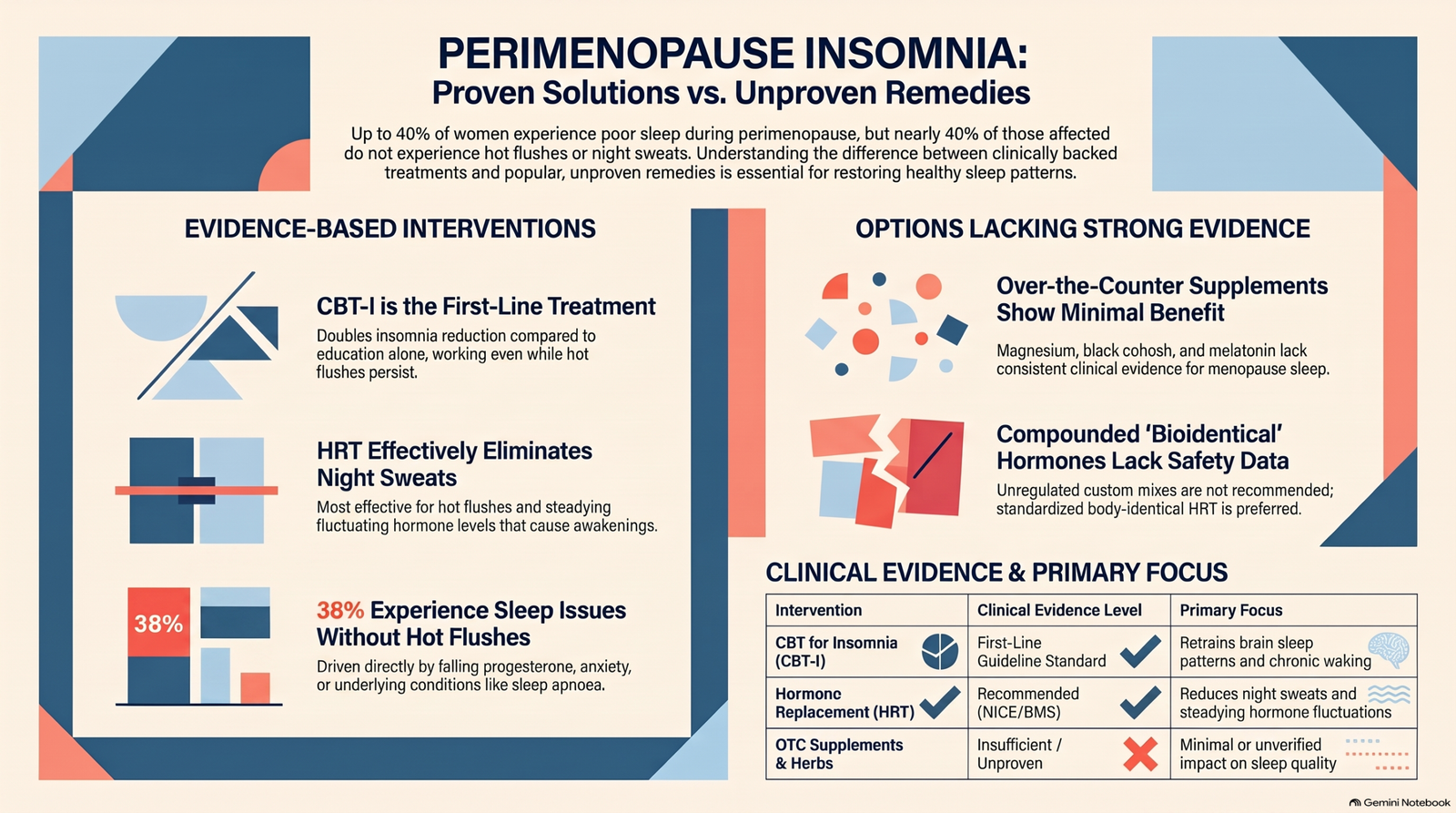
In a large US survey analysis, 61.7% of women in perimenopause reported sleep problems along with hot flushes or night sweats. But 38% reported sleep problems without them.[4] SWAN found the same thing: sleep difficulties stayed higher even in women without hot flushes.[3]
So if you're waking at 3am but you're not drenched, it can still be perimenopause. And it can also be something else worth checking, which we'll come to.
Why perimenopause disrupts sleep
There's rarely one single cause. For one woman, night sweats are the main problem. For another, it's anxiety, or restless legs, or sleep apnoea. Often it's a mix.[2]
1. Hot flushes and night sweats
Hot flushes come from changes in the part of the brain that controls body temperature.[7] At night, they can wake you up or make it hard to get back to sleep. Women with more frequent, more severe flushes are more likely to report insomnia.[6]
It works both ways, though. Sometimes you wake first and the flush comes with it, so "the flush woke me" isn't the only pattern.[8]
2. Hormone changes acting on sleep directly
During perimenopause, oestrogen and progesterone go up and down before they settle lower. Hormone changes are linked to broken sleep even when there are no other symptoms. Falling oestrogen and rising FSH (a hormone that rises as the ovaries slow down) are linked to more awakenings.[2]
Progesterone has a calming, sleep-promoting effect.[6] But the evidence on falling natural progesterone and sleep is weaker and mixed, so it's not the whole story.[2][6]
You may also notice your sleep is worse in the days before a period. One study of perimenopausal women found less efficient, shorter sleep with more awakenings in that phase of the cycle.[6]
3. Mood, stress and anxiety
Anxiety and low mood make it harder to settle, and harder to get back to sleep. Then a bad night makes the next day harder. Depression and anxiety are linked to sleep problems in perimenopause research.[3][8] That doesn't mean it's "all in your head". It means mood is worth asking about alongside the physical symptoms.
4. How short-term sleep trouble becomes long-term
Perimenopause can trigger insomnia, and ongoing symptoms can keep it going. Then habits creep in. You spend longer in bed hoping to catch up, or you start to dread bedtime. Over time, your brain links bed with being awake. That's why insomnia can carry on even after the original trigger improves.[2]
5. Ageing plays a part too
Sleep naturally gets lighter and more broken with age, and the body clock shifts a little earlier.[2] Not every midlife sleep change is down to menopause. If you're also waking very early, our guide to why sleep changes after 50 covers that side of it.

Other sleep problems that become more common
These are easy to miss, because it's tempting to put everything down to hormones.
Sleep apnoea. This is when your airway narrows or closes repeatedly while you sleep. It becomes more likely after menopause. In one long-term study, postmenopausal women were 2.6 times more likely to have at least mild sleep apnoea than premenopausal women, even after allowing for age and weight.[9]
It's also underdiagnosed in women, because it often looks different. Women are more likely to have morning headaches, low mood, nightmares, tiredness and insomnia, and less likely to report snoring.[2]
Restless legs. An urge to move your legs, often with uncomfortable feelings, that's worse in the evening or at rest and eases when you move. Iron deficiency is a common and reversible cause, so the BMS says anyone with symptoms should have their iron stores (ferritin) checked. It suggests offering iron treatment if ferritin is below 90, so it's worth asking for the actual number, not just whether it's "normal".[2]
Needing the toilet at night. This can be linked to menopause changes in the bladder and vagina. But it can also be a sign of sleep apnoea, so it's worth mentioning to your doctor rather than assuming it's hormones.[2]
What actually helps perimenopause insomnia
1. CBT for insomnia (CBT-I)
CBT-I is the first-line treatment for chronic insomnia recommended by the UK's National Institute for Health and Care Excellence (NICE) and international guidelines.[2] It's not just "relax more" or a list of sleep tips. It's a structured programme that usually takes 6 to 8 weeks. It can be done one-to-one, in a group, from a book, or through an app.[2]
It's also not general talk therapy. CBT-I targets the habits and worries that keep insomnia going once it has started. It usually combines a few parts:[10][2]
- Stimulus control: retraining your brain to link bed with sleep again, rather than with lying awake, clock-watching and struggling.
- Adjusting your time in bed: spending less time lying awake in bed, guided by the programme. This is sometimes called sleep restriction.
- Changing unhelpful thoughts about sleep: easing the worry and dread that can build up around bedtime.
- Relaxation and learning how sleep works.
The time-in-bed part is powerful on its own. In one trial of postmenopausal women with insomnia, full CBT-I cut insomnia scores by 7.7 points and sleep restriction alone by 6.5, compared with just 1.1 for sleep hygiene advice.[22] If you've been diagnosed with chronic insomnia, the BMS recommends CBT-I specifically, rather than CBT aimed at menopause symptoms or mood.[2]
It works well during perimenopause. In a US trial of 106 women aged 40 to 65 with insomnia and daily hot flushes, CBT-I delivered over the phone roughly doubled the drop in insomnia scores compared with menopause education. Six months later, 84% of the CBT-I group were in the "no insomnia" range, compared with 43% of the education group.[10]
Here's the interesting part. The women's hot flushes didn't become less frequent, but their sleep still improved, and the flushes bothered them less day to day.[10] So you don't need to wait for the hot flushes to stop before tackling insomnia.
Another trial, of 150 postmenopausal women whose insomnia started or got worse around menopause, also found CBT-I worked well, with more than half no longer having insomnia six months later.[11]
How to get it: ask your GP or doctor for CBT-I specifically. Trained therapists are in short supply, but online CBT-I is widely available and works, though a little less well than face-to-face.[2] In the UK, examples include Sleepio, Sleepstation and Sleepful.[2]
NICE also recommends considering menopause-specific CBT for sleep problems that come with hot flushes, either alongside HRT or instead of it.[12]
2. HRT (hormone replacement therapy)
HRT is the most effective treatment for hot flushes and night sweats, and NICE recommends offering it for them.[12] When night sweats are waking you up, treating them often improves sleep.
The BMS says HRT can also help sleep in other ways: by easing low mood, anxiety and bladder symptoms, and directly, by steadying hormone levels. That means it may help insomnia linked to perimenopause even without hot flushes.[2] HRT patches, gels and tablets have all been shown to improve sleep.[2]
One thing worth asking about: if you still have a womb, HRT includes a progestogen to protect the womb lining.[12] The BMS says micronised progesterone may be better for sleep than other types, although the research on it for menopause sleep is still limited.[2][14]
The way it's taken matters. Taken by mouth, some of it is turned into a substance called allopregnanolone, which acts on the brain's natural calming system, known as GABA. Taken vaginally, very little is converted, so it's unlikely to help sleep.[2] Its licensed use is protecting the womb, so using it purely for sleep would be outside its licence. That's a conversation for your doctor.[2]
But HRT isn't a guaranteed cure for insomnia. Results vary, especially in studies that measure sleep objectively.[13] If sleep problems carry on while you're on treatment, the BMS advises checking the dose and type are right for you, and looking again for other sleep problems like sleep apnoea or restless legs.[2] If it's insomnia that's carrying on, CBT-I is the next step.[2]
The Menopause Society says HRT is generally considered for women with symptoms who are under 60 or within 10 years of their last period, if there's no medical reason against it.[7] It's an individual decision, so talk through your own benefits and risks with your doctor.
3. Non-hormonal options if HRT isn't right for you
Several prescription medicines reduce hot flushes without hormones. These include some antidepressants (such as paroxetine, citalopram and venlafaxine), gabapentin and fezolinetant.[15] None works as well as oestrogen, and they treat hot flushes rather than insomnia itself.[15]
- NICE says not to routinely offer antidepressants as the first choice for hot flushes alone.[12]
- Gabapentin can cause drowsiness and dizziness.[15]
- Fezolinetant is recommended by NICE when HRT isn't suitable.[21] In the US, the Food and Drug Administration (FDA) has added a warning about rare but serious liver injury, so it needs liver blood tests before and during treatment.[16]
4. Treat any other sleep problem
If snoring, breathing pauses, restless legs or night-time toilet trips are part of the picture, they can be assessed and treated in their own right.[2]
5. Make nights easier
These won't cure insomnia on their own. The BMS says sleep habits alone usually aren't enough to treat a sleep disorder.[2] But they make nights more bearable and support everything else.
- Keep cool. A cool, dark, quiet room, light nightwear, layers you can throw off, and a spare top or sheet within reach.[8]
- Keep regular times. Go to bed and get up at the same time each day.[8]
- Watch the evening drinks. Avoid caffeine late in the day. Alcohol won't help you sleep: even small amounts make it harder to stay asleep.[8]
- Move, but not late. Exercise at regular times, but not close to bedtime.[8]
- Keep a sleep diary. Note waking times, sweats, mood, drinks and toilet trips. It helps spot patterns, and it gives your doctor a much clearer picture.[2]
Cooling down and avoiding triggers can make you more comfortable. But they haven't been shown to reduce hot flushes themselves.[7]
What doesn't have good evidence
A lot of what's sold for menopause sleep doesn't hold up.
- Black cohosh: reviews found insufficient evidence that it helps, and rare cases of liver damage have been reported.[18][7]
- Magnesium: often recommended, but the BMS notes a lack of evidence, even for restless legs.[2] A US guideline found insufficient evidence for it for hot flushes.[17]
- Over-the-counter melatonin: a pooled analysis found no difference from a dummy pill for hot flushes or sleep quality, though the evidence was weak overall.[17] A prescription form is licensed in the UK for short-term insomnia in people over 55, mainly helping you fall asleep rather than stay asleep.[2]
- Soy: mixed results for hot flushes, and not recommended as a treatment.[17][7]
- "Bioidentical" compounded hormones: custom-mixed hormone products aren't regulated, and their safety and effectiveness are unknown. UK and US menopause bodies don't recommend them.[19][20] The saliva and blood hormone tests often used to "tailor" them aren't supported by evidence.[19] Regulated body-identical HRT is available on prescription instead.[19]
If you're thinking of trying a supplement, check with your doctor or pharmacist first, especially if you take other medicines.
Does perimenopause insomnia go away?
For most women, it gets better. SWAN found that after menopause, sleep problems stabilise or improve for the majority of women.[5] Only a small group, about 15%, had problems that kept increasing.[5]
But it doesn't always settle by itself, and it can carry on for some.[3] So it's worth treating now rather than waiting it out.
Key takeaways
- Perimenopause insomnia is common: up to 40% of women report poor sleep, and about 1 in 4 meet the criteria for chronic insomnia.
- It's not always hot flushes. Hormones, mood, sleep apnoea and restless legs can all play a part.
- CBT-I is the first-line treatment for ongoing insomnia, and it works even while hot flushes continue.
- HRT often helps, especially when night sweats are waking you, but it isn't a guaranteed insomnia cure.
- Most menopause sleep supplements and "bioidentical" compounded hormones lack good evidence.
Frequently asked questions
Can perimenopause cause insomnia?
Yes. Sleep problems rise through perimenopause and peak in its late stage. Hot flushes are one cause, but hormone changes affect sleep directly too, and many women have insomnia without any hot flushes at all.[2][3][4]
Why do I wake up at 3am in perimenopause?
Waking in the night is the most common sleep complaint around menopause. Night sweats, hormone changes, anxiety, needing the toilet, or sleep apnoea can all cause it. If you then lie awake worrying, that can turn it into a habit. A sleep diary can help you and your doctor spot the cause.[2][6]
Does HRT help with perimenopause insomnia?
Often, yes. HRT is the most effective treatment for night sweats, and treating them usually improves sleep. It may also help sleep directly. But it doesn't fix every case of insomnia. If sleep problems continue on HRT, CBT-I is the recommended next step.[2][12][13]
How long does menopause insomnia last?
It varies. Sleep problems tend to peak in late perimenopause, and for most women they stabilise or improve after menopause. For some they carry on, so it's worth getting help rather than waiting it out.[3][5]
Why is my sleep worse before my period?
In perimenopause, sleep can be worse in the days before a period, when progesterone falls. One study found shorter, less efficient sleep with more awakenings in that phase.[6]
Do supplements help perimenopause sleep problems?
The evidence is weak. Black cohosh, magnesium, shop-bought melatonin and soy haven't been shown to reliably help menopause sleep or hot flushes. CBT-I and, where suitable, HRT have much stronger evidence.[2][17][18]
References
- Andersen ML, et al. Sleep in women: a narrative review of hormonal influences, sex differences and health implications. Frontiers in Sleep. 2023.
- Schaedel Z, British Menopause Society. Managing sleep disturbance during the menopause transition. BMS Tool for Clinicians. Reviewed August 2026.
- Kravitz HM, Joffe H. Sleep During the Perimenopause: A SWAN Story. Obstetrics and Gynecology Clinics of North America. 2011;38(3):567–586.
- Lyu AC, Kravitz HM. Sleep Disruption in the Menopausal Transition and Postmenopause: A Narrative Review. Obstetrics & Gynecology. 2026.
- SWAN Study. Effects of Sleep Problems During Menopause. 2025.
- Troìa L, et al. Sleep Disturbance and Perimenopause: A Narrative Review. Journal of Clinical Medicine. 2025.
- The Menopause Society. 2023 Nonhormone Therapy Position Statement. 2023.
- National Institute on Aging. Sleep Problems and Menopause: What Can I Do?. 2021.
- Baker FC, et al. Sleep and sleep disorders in the menopausal transition. Sleep Medicine Clinics. 2018;13(3):443–456.
- McCurry SM, Guthrie KA, Morin CM, et al. Telephone-Based Cognitive Behavioral Therapy for Insomnia in Perimenopausal and Postmenopausal Women With Vasomotor Symptoms: A MsFLASH Randomized Clinical Trial. JAMA Internal Medicine. 2016;176(7):913–920.
- Optimizing Sleep across the Menopausal Transition. PubMed Central. 2023. (Reviews Drake CL, Kalmbach DA, Arnedt JT, et al. Sleep. 2019;42(2).)
- NICE. Menopause: identification and management (NG23). Updated November 2024.
- The North American Menopause Society. The 2022 Hormone Therapy Position Statement. 2022.
- Women's Health Concern. Menopause and insomnia. Factsheet. August 2025.
- British Menopause Society. Non-hormonal-based treatments for menopausal symptoms. Consensus statement. July 2026.
- US Food and Drug Administration. FDA adds warning about rare occurrence of serious liver injury with use of Veozah (fezolinetant) for hot flashes due to menopause. Drug Safety Communication.
- US Department of Veterans Affairs / Department of Defense. Clinical Practice Guideline for Menopause. 2026.
- NIH Office of Dietary Supplements. Black Cohosh: Health Professional Fact Sheet.
- British Menopause Society. Bioidentical HRT. Consensus statement. April 2026.
- American College of Obstetricians and Gynecologists. Compounded Bioidentical Menopausal Hormone Therapy. Clinical consensus. 2023.
- NICE. Fezolinetant for treating vasomotor symptoms associated with the menopause (TA1143).
- CBT-I and women's health: Sex as a biological variable. PubMed Central. 2019. (Reviews the Drake et al. 2019 trial of 150 postmenopausal women.)
Last reviewed: [date of publishing]
This article is for general information only and isn't medical advice. Talk to your doctor about your own sleep and health.
More from Age On Your Terms: subscribe on YouTube for more on ageing well, without the fear-mongering.

Matt is a UK-based project manager in his late 50s, heading into his pre-retirement years. He started Age On Your Terms to work out what the next chapter really holds, digging into the health, lifestyle and money questions he's facing himself, and sharing what he finds with people in the same position. He's not a doctor or financial adviser; he goes to the research and shows you where it comes from. When he's not doing that, you'll find him on the golf course.
View All Articles