


You're tired by 9pm. You're wide awake at 4:30am.
If that sounds familiar, you're not alone, and it doesn't automatically mean something is wrong.
In this article, we'll cover what's actually changing, how to tell a normal shift from a real sleep problem, and what the evidence says helps.
I'm Matt. I'm in my 50s and going through these changes myself. I'm not a doctor, so I've gone through the research properly, and every claim below links to where it comes from.
▶ Video goes here — embed the YouTube video once it's published.
How common are sleep problems in older adults?
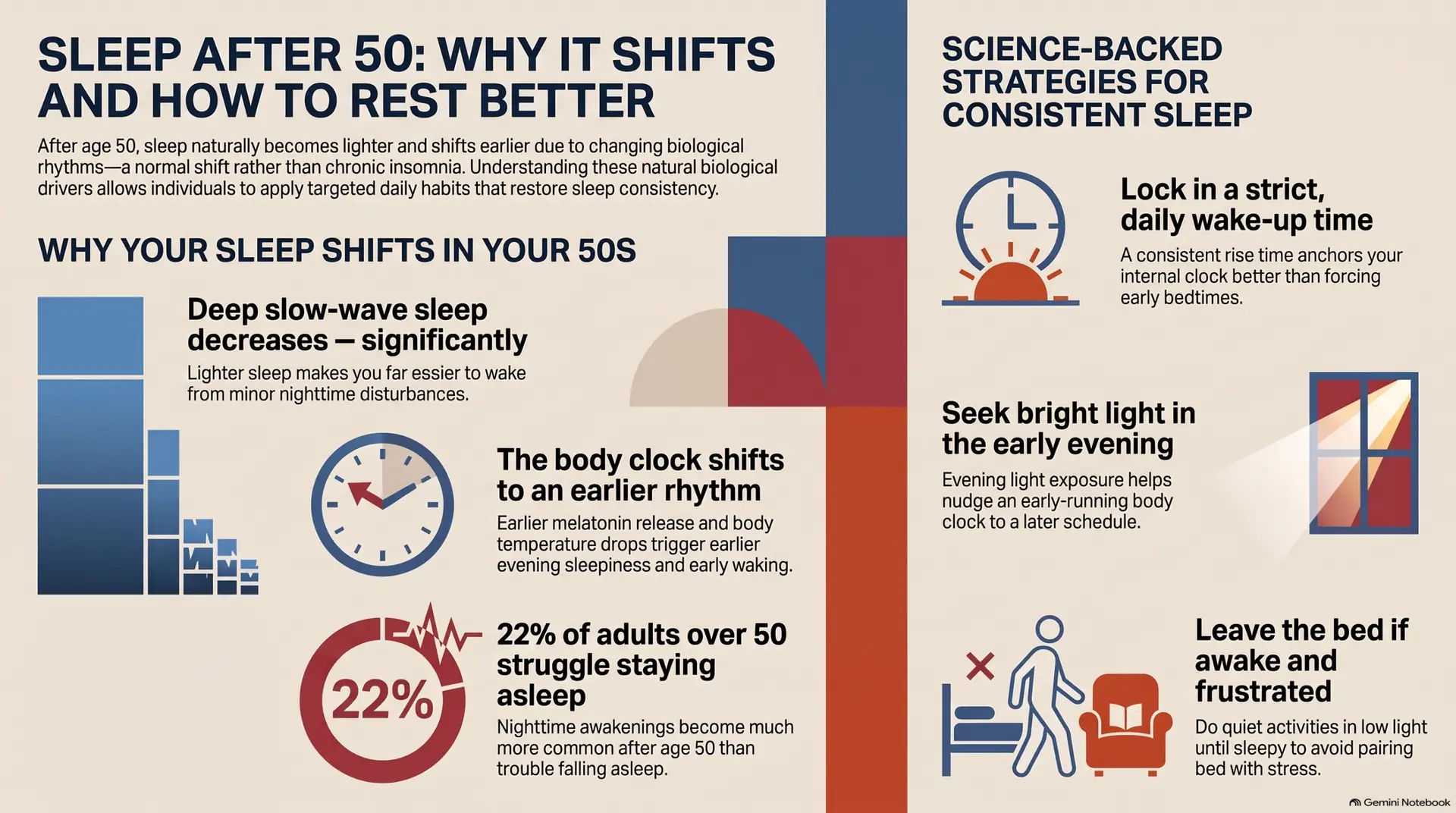
Very common. In a 2024 national survey of US adults, 22.3% of people aged 50 to 64 said they had trouble staying asleep on most days or every day in the past month. For people 65 and older, it was 21.7%. That's compared with 12.7% of adults aged 18 to 34.[1]
Interestingly, trouble falling asleep goes the other way. It's a little less common with age.[1] So the typical sleep problem after 50 isn't lying awake at bedtime. It's waking up too early, or waking up during the night.
Keep in mind, those survey numbers are about symptoms, not a diagnosis. Actual insomnia disorder is less common. A 2023 review that pooled 16 studies put it at about 1 in 5 older people, though the estimates varied a lot between studies.[2]
What changes in your sleep as you age?
Two things change, and they usually happen together.
1. Your deep sleep gets lighter
Sleep isn't one steady state. Through the night you cycle through lighter stages and a deeper stage called slow-wave sleep. That's the solid, hard-to-wake-from part of the night.
As we age, the brain gets less good at producing strong, steady deep sleep.[3] In a well-known study published in JAMA, deep sleep made up almost 19% of the night in men aged 16 to 25, but only about 3% in men aged 36 to 50. It was replaced by lighter sleep.[3]
That study only looked at healthy men. It also found something worth knowing if you're over 50. Through midlife, sleep got lighter without getting much more broken up. But after about age 50, waking during the night became significantly more common.[3]
Think of deep sleep as a strong, steady signal. When it's strong, small things don't wake you: a noise, a change in temperature, a full bladder. When the signal gets quieter, those same small things are more likely to pull you awake.[4]
2. Your body clock shifts earlier
Your body clock, or circadian rhythm, is the internal timer that decides when you feel sleepy and when you wake up. With age, it tends to run earlier. The timing of your melatonin release and your body temperature rhythm both move earlier too.[5][6]
Put those two changes together and you get the classic pattern: sleepy earlier in the evening, awake earlier in the morning, and sleep that's a bit easier to interrupt along the way.
That doesn't mean your ability to sleep is broken. The signal is a little quieter and the timing has moved. That's a very different problem, and a much more fixable one.
Do older adults need less sleep?
No. This is one of the most common myths about ageing. Older adults still need about 7 to 9 hours a night.[6] What changes is how easily you get that sleep and how well you stay in it, not how much your body needs.
Is waking up at 4am a sign of insomnia?
Not by itself. Doctors define chronic insomnia as trouble falling asleep, staying asleep, or waking too early, at least three nights a week, for at least three months, and it has to affect how you feel or function during the day.[7]
One early morning doesn't meet that bar. Neither does a shift that leaves you sleeping a bit earlier but still feeling fine.
What this looked like for me
(That 7am dip is my own experience. The research I went through doesn't describe it as a specific pattern, but it fits with sleep that's lighter and a clock that's moved.)
How to stop waking up too early: what actually helps
These are ordered from what targets the real cause to the supporting habits.
1. Keep your wake-up time the same every day
A steady wake-up time is the most useful anchor for your body clock. It matters more than trying to force a particular bedtime. Same time most days, weekends included.
2. Get light at the right time of day
Light is the strongest signal your body clock responds to.[8] You'll often read that morning sunlight "resets your clock." But if your clock has already shifted earlier, more bright morning light can push it even earlier, and that can make early waking worse.
For an early-running clock, it's evening light that nudges it later. Sleep doctors' guidelines support evening light for this, though they rate the evidence as limited and the recommendation as weak.[9] So treat it as a sensible thing to try, not a guaranteed fix. Spending time outside or in bright light in the early evening is an easy place to start.
3. Don't go to bed earlier to "catch up"
If you're waking at 4:30, it's tempting to go to bed at 8 to get more hours in. That usually backfires. You end up lying awake, or waking even earlier, because your body isn't ready for sleep yet. Keep your bedtime realistic and let the steady wake time do the work.
4. If you wake at 4am and can't get back to sleep, get up
This feels backwards, but it's what the main treatment for insomnia recommends. If you're awake and not drifting off, don't lie there fighting it. Get up, do something quiet in low light, and go back to bed when you feel sleepy. Keep the bed for sleep (and sex), and try not to watch the clock.[10]
There's no strict 15-minute rule. The point is not to let the bed become a place where you lie awake and frustrated. If it's close to your normal wake time and you've slept enough, it can make more sense to just start your day. And if your balance isn't what it was, make sure the route out of the bedroom is lit well enough to avoid a fall.[10]
5. Watch the evening drinks
A nightcap can help you drop off, but it tends to backfire later. As your body processes the alcohol, often around four to five hours after you fall asleep, sleep gets lighter and more broken in the second half of the night.[11] Older adults can also be more sensitive to alcohol's effects.[12] If early waking is a problem, try a few alcohol-free evenings and see if anything changes.
6. If it really is insomnia, ask about CBT-I
If your sleep does meet that insomnia definition, the best-supported treatment isn't sleeping pills or a list of sleep tips. It's cognitive behavioural therapy for insomnia (CBT-I), a structured, drug-free programme. Guidelines recommend it as the first treatment for chronic insomnia at any age, and its benefits last longer than sleeping pills.[13][14]
7. Look at what's actually waking you up
Some causes are specific and treatable:
- Loud snoring, gasping, or choking during sleep isn't typical ageing. It's worth getting checked for sleep apnoea.[15]
- Hot flushes or night sweats are one of the best-supported reasons for waking during perimenopause and menopause.[16] Hormone therapy is the most effective treatment for them, for the right person after a proper assessment. There are non-hormonal options too.[17][18] In one trial, CBT-I improved sleep for women during and after menopause. It didn't stop the hot flushes, but they bothered people less.[16]
- Night-time trips to the toilet, pain, restless legs, or medication side effects can all break up sleep and are worth raising with your doctor.[4]
8. The basics help, but they're not a cure
A regular schedule, less caffeine and alcohol late in the day, a dark and cool bedroom, and shorter naps all help. On their own, though, they won't fix chronic insomnia or a medical cause.[13] If you're doing all of this and still struggling most nights, it's time to talk to a professional, not to look for more sleep tips.
What about melatonin?
Be cautious. Melatonin is a timing hormone, not a general sleeping pill, and the evidence for it fixing ordinary age-related early waking is mixed.[9] It's more useful for specific body-clock problems. Talk to your doctor or pharmacist before taking it.
Key takeaways
- After 50, deep sleep gets lighter and your body clock shifts earlier. That explains most early waking.
- Waking at 4 or 5am isn't insomnia unless it happens at least three nights a week, for three months, and affects your day.
- Keep a steady wake-up time, and try evening light rather than more morning light.
- If you can't get back to sleep, get up and return when sleepy, rather than lying there.
- Snoring, hot flushes, low mood, or a sudden change are worth a conversation with your doctor.
Frequently asked questions
Is waking up at 4am normal as you get older?
It can be. As your body clock shifts earlier with age, an early start is common, especially if you're also getting sleepy earlier in the evening. It's only a concern if it's leaving you tired or struggling during the day, or if it comes with other symptoms like snoring or low mood.[5][7]
Why do I wake up so early even if I go to bed late?
If your body clock has shifted earlier with age, it can still wake you early even after a late night, because the clock, not your bedtime, is what's driving the early start. A steady wake time and evening light are the best ways to work with it.[5][9]
How do I stop waking up at 5am?
Keep the same wake-up time every day. Get bright light in the evening rather than first thing in the morning, and don't move your bedtime earlier to compensate. Cut back on evening alcohol. If none of that helps and it's affecting your days, ask your doctor about CBT-I.[9][10][11][13]
Should I stay in bed if I wake up too early?
Not if you're wide awake and frustrated. The advice from insomnia treatment is to get up, do something quiet in low light, and go back to bed when you feel sleepy. If you're relaxed and feel you might drift off, it's fine to stay put.[10]
Do older adults need less sleep?
No. Older adults still need about 7 to 9 hours a night. Sleep often gets lighter and more broken with age, but the amount your body needs doesn't drop much.[6]
References
- Ng AE, Black LI, Adjaye-Gbewonyo D. Short Sleep Duration and Sleep Difficulties Among Adults: United States, 2024. NCHS Data Brief No. 559. National Center for Health Statistics, CDC; 2026.
- Endomba FT, Tchebegna PY, Chiabi E, Angong Wouna DL, Guillet C, Chauvet-Gélinier JC. Epidemiology of insomnia disorder in older persons according to the Diagnostic and Statistical Manual of Mental Disorders: a systematic review and meta-analysis. Springer; 2023.
- Van Cauter E, Leproult R, Plat L. Age-related changes in slow wave sleep and REM sleep and relationship with growth hormone and cortisol levels in healthy men. JAMA. 2000;284(7):861–868.
- Sleep in the Elderly. PubMed Central.
- Aging and Circadian Rhythms. PubMed Central.
- National Institute on Aging. Sleep and Older Adults.
- American Academy of Sleep Medicine. International Classification of Sleep Disorders (ICSD-3-TR): Insomnia.
- Circadian rhythm review. PubMed Central.
- Auger RR, et al. Clinical Practice Guideline for the Treatment of Intrinsic Circadian Rhythm Sleep-Wake Disorders. American Academy of Sleep Medicine; 2015.
- American Academy of Sleep Medicine. Behavioral and Psychological Treatments for Chronic Insomnia Disorder in Adults: Clinical Practice Guideline (2021) and patient guide.
- Roehrs T, Roth T. Sleep, Sleepiness, and Alcohol Use. Alcohol Research & Health. 2001.
- National Institute on Alcohol Abuse and Alcoholism. Aging and Alcohol.
- European Insomnia Guideline 2023. Journal of Sleep Research. 2023.
- Cognitive Behavioral Therapy for Insomnia (CBT-I): A Primer. PubMed Central.
- Screening for Obstructive Sleep Apnea in Adults. JAMA.
- Sleep problems during the menopausal transition. PubMed Central.
- The North American Menopause Society. The 2022 Hormone Therapy Position Statement. 2022.
- The Menopause Society. 2023 Nonhormone Therapy Position Statement. 2023.
- Alberta Medical Association. Managing Insomnia.
Last reviewed: [add the date when you publish]
This article is for general information only and isn't medical advice. Talk to your doctor about your own sleep and health.
Watch the video: The Real Reason You Wake Up Earlier After 50 (It's Not Insomnia) [add YouTube link once live] — and subscribe on YouTube for more on ageing well, without the fear-mongering.

Matt is a UK-based project manager in his late 50s, heading into his pre-retirement years. He started Age On Your Terms to work out what the next chapter really holds, digging into the health, lifestyle and money questions he's facing himself, and sharing what he finds with people in the same position. He's not a doctor or financial adviser; he goes to the research and shows you where it comes from. When he's not doing that, you'll find him on the golf course.
View All Articles